
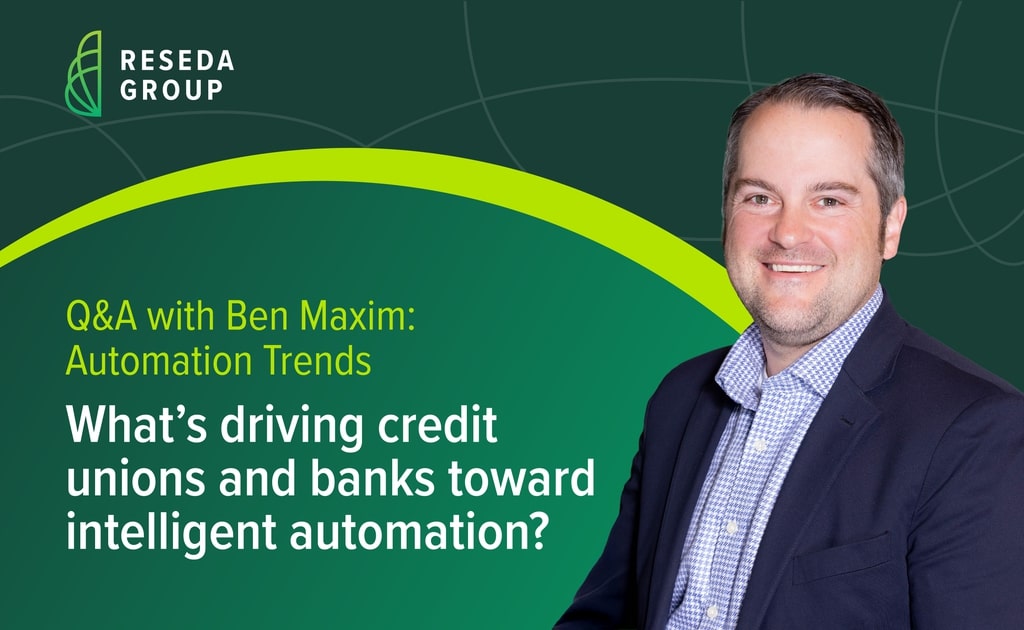
Reseda Group’s Ben Maxim was featured in American Banker with other financial industry experts to weigh on why banks and credit unions alike are doubling down on efforts to adopt more intelligent automation tools.
With his extensive fintech experience and hyperawareness of the latest tech trends, we talked with Ben to gain deeper insights into the growing use of automation and artificial intelligence in financial services, as well as what’s on the horizon.
Q: One of the core uses for AI in the banking world is automation. Can you talk about the pace of this trend in recent years and how you think it will evolve in the years to come?
Maxim: Automation is a spectrum. AI is the culmination of this spectrum, where more advanced automation facilitated by AI agents/agentic AI can augment the workforce, which will be key to financial institutions surviving the economic pressures of the future. Automation can start on one end with business process outsourcing (BPO), a way to get relief to overwhelmed teams by using lower-cost human options. Then, there’s robotic process automation (RPA), which is a lightweight/lower-tech fix for repetitive work. Rules-based automation can also be built directly into core systems and function as that next level of automation. AI of many flavors can support the automation many are hoping for in the future.
The speed and adoption of automation has increased over the past five years as the technology and understanding of that technology by leaders has improved. There have been pauses with AI related to LLMs due to the lack of understanding of how these solutions worked, causing boards and risk teams to throw up flags; but as governance has been figured out, we have seen the pace of LLMs pick up steam.
Q: Fraud detection, risk management, and customer personalization have been identified by bankers as top areas for automation. Do you think banks and credit unions can lean too heavily into automation? What are the dangers in doing so?
Maxim: Yes, especially community focused institutions — where humans are the differentiating factor. It is important to maintain a human-in-the-loop structure, where complex tasks or more social/relationship tasks benefit from human intelligence and emotional intelligence. If you are making it impossible to talk to a human when they have chosen to walk into the branch, it will not be appreciated.
Q: How does the scale of a financial institution factor into the degree to which it can automate processes? Can the smallest bank or credit union be as tech-forward as the largest?
Maxim: Absolutely. Smaller institutions may have greater ability to automate more out of necessity. They can reap greater rewards, allowing them to grow faster sooner. Larger institutions may be less incentivized to move forward.
Q: What areas or functions within a bank or credit union would you consider untouchable when it comes to AI and automation? Why?
Maxim: All processes can benefit from AI in some way, as long as there are human-in-the-loop components. AI can assist those supporting the customers both directly and indirectly.
Financial technologies are evolving fast, and consumers are adapting in real time. Reseda Group is committed to supporting financial institutions through our ecosystem of breakthrough products and high-tech financial services platforms designed to meet the needs of today’s digital savvy consumers. Contact us today to learn how we can help.


